Roundup #32: LLMs vs Chess Computers, Changing your mind on AI, and I bought a legendary record player
Actually, I might get away with calling it an 'investment' in a legendary piece of music technology.

A collection of random interesting things that caught my eye, as usual.
A very interesting piece comparing LLMs in language to Chess Computers in Chess

That’s why the AI feels like an “alien” to the grandmaster. The computer does not form gestalts and therefore act with any sort of discernible personality, spirit, vitality, or “ethos.” It’s a bit like trying to compete with a calculator at a game of adding large numbers in your head. Yeah, it wins, but so what?
Magnus can’t compete with the computers, but millions still want to watch Magnus because Magnus has a personality, including a risk tolerance, aggression, sportsmanship, mindgames and therefore morality. It’s fun to watch him for the same reason it’s fun to watch athletes: we want to see how great people apprehend the world in real time, from within their bodies, which is a gestalt judgment, rather than a set of strictly measurable skills. This all manifests automatically as “admiration.”
And more:
Most people, I find, think that thinking is language. But that’s not true. Thinking is embodied. I know this because if you lose the parts of your ancient cerebellum where you visualize and move your body through space, you can no longer think. Words are just what happens, very automatically at this point, when we look back and try to record a thought, which itself was a rush of images and sensations. This is made even more obvious, also, when you realize that words are themselves intricate metaphors for embodied actions - the word “metaphor” is itself a metaphor, for example, meaning in Greek “to carry across.”
Like chess, language has relatively simple rules, so almost anyone can play, but uncountable possible combinations, therefore a very high skill ceiling. These are the qualities of any good game, you will notice.
The large language models are getting better at and even approaching “solving” the language game. This will, no doubt, shake our world to the core. Many people will lose their jobs, I’m sure. What’s terrifying about this inevitability, however, is not the possibility of AI stealing our humanity. It can’t. Rather, it’s the sad fact that such a large number of people make their living pushing linguistic symbols around in arbitrage, like a machine. This is an existential threat to investment bankers and performance marketers, maybe, but if perfect chess robots don’t make Magnus Carlsen irrelevant, I struggle to see how LLM’s are suddenly going to start “solving” reality more generally just because they “solve” the simplified game we created to represent it.
More in the category of what consciousness and thinking actually is, which I’ve been spending quite a bit of time on. Definitely worth a full read!
Dwarkesh with a great bit on changing your mind as more knowledge becomes available
But some amount of goal post shifting is justified. If you showed me Gemini 3 in 2020, I would have been certain that it could automate half of knowledge work. We keep solving what we thought were the sufficient bottlenecks to AGI (general understanding, few shot learning, reasoning), and yet we still don’t have AGI (defined as, say, being able to completely automate 95% of knowledge work jobs). What is the rational response?
It’s totally reasonable to look at this and say, “Oh actually there’s more to intelligence and labor than I previously realized. And while we’re really close to (and in many ways have surpassed) what I would have defined as AGI in the past, the fact that model companies are not making trillions is revenue clearly reveals that my previous definition of AGI was too narrow.”
Really like this. It feels like people (Americans more than others?) are vulnerable to lock themselves into a point of view. People also really like to sneer at others who were wrong in the past which is usually counterproductive. But I’m fully on board with Dwarkesh here on principles. When I first saw ChatGPT I also thought it would improve faster, and that it would be able to do more with smart tooling and more compute. It’s healthy to look at that and update your views. Unhealthy to just keep doubling and tripling down. Unless you run a company that critically depends on the hype continuing, perhaps..
The latest series of AI models are tangible progress in coding
For my ‘vibecoded’ side project Magicdoor.ai there are a number of features for which I have had detailed plans ready for many months. They are difficult and serious additions or complex full-stack changes that I know would take me many hours across a week or more with models from a year ago. Every now and then I try them with newer models. The generation from last May/June (Claude 4, GPT-5) still failed.
But Claude Opus 4.5 is different. It could be luck, but it actually completed one of these projects in about 10 prompts over the course of 24 hours. I’m impressed! This is real progress in that it can complete a project that AI could not before.
Just to make clear that while LLMs are not the apocalyptic / walhalla breakthrough (AGI) that they were marketed to be, they are also not useless and have not stagnated. Progress may not be exponential, but there is progress and we should continue to expect further progress.
Extremely good and accessible read on AI Chips

AI Browser innovation
I’ve so far tried every major AI powered web browser: Arc, Dia, Comet, and Atlas. The only one I love is Arc, and that has more to do with its non-AI features and UI. It’s been generally underwhelming so far.
But Google has now announced something called Disco, which is starting to show some interesting ideas. It can create mini-apps on the fly, which is the first real step towards ‘Generative UI’. It can obviously research things and present that in novel ways. This feels like one of those old Googley conceptual things like Inbox, which I really loved at the time.
Even signing up for the waitlist is only possible for US residents, but I’ll keep an eye on this one and hope to try it soon.
Just a cool picture of a bird

When you can see the melody. A bird singing in the cold in Russia, creating small puffs of vapor with its breath. Photographed by Mikhael Kalinin in 2017.
When I came across this image my first thought was “that’s probably AI”, as now almost every notable video on Instagram turns out to be. But I checked, and it’s not. That makes me happy. Captures of the real world are much more special than AI generated images.
AI content is going to take off, there is no escaping it. But ‘real’ content will also premiumize, I’m certain of it. Live music, human writing, paintings, documentaries. What else? And what to do about it?
I got a new record player
My bucket-list is one item shorter, a route to learning something I’ve always wanted to learn has been started, and an unfortunate new black hole for money has been opened.
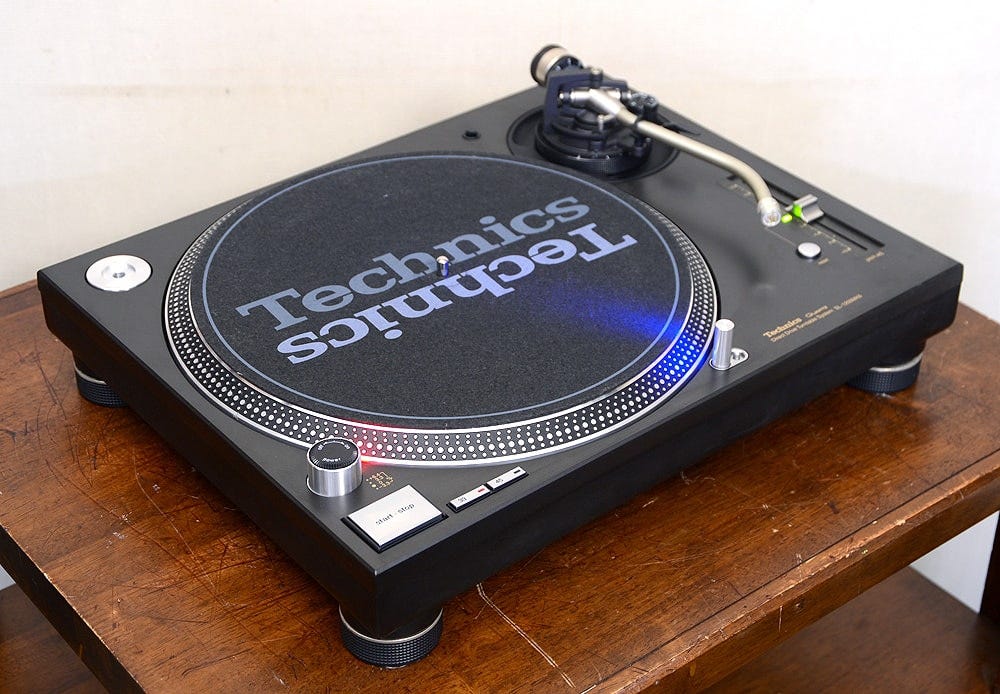
This is a Technics SL1200 turntable. It was first released by the company that later became Panasonic, in 1972. It is near indestructible, and it has a very powerful ‘direct drive’ motor which made it keep a very consistent speed. In New York, some people discovered that these qualities made it possible to scratch and loop records without destroying the turntable. In the video below, look closely at the moments when the DJ has two identical records (it will be obvious from the labels). Notice that he is effectively looping the same bit of music by spinning back one of the records and ‘throwing’ it back into the mix on the beat. Doing that with funk and disco records is how breakdancing and hiphop started in the 70s. Not possible without SL1200s.
Technics was smart enough to lean into this innovative use of their product and in the 1979 Mk2 version they added a pitch control for finetuning the rotation speed. That addition paved the way to DJs matching the tempo of two different records to create a smooth transition. That was important for scratching and hip hop, but it was critical for house and techno DJs in the late 80s and 90s. Some of the early day legends like Jeff Mills matched tempos and juggled records across three SL1200s, sometimes playing all three at the same time.
When I was actively DJ’ing, I enjoyed learning the skill of beat matching and creating great transitions. Ideally the audience would be a bit confused whether one or two records are playing, and where one starts and the other ends.
Modern DJ equipment makes this very easy. All songs are ‘analyzed’ and set to a ‘beat grid’. Big screens visualize the music and this grid. It is even possible to let the software line up the grids automatically, so you only have to press play at the right time. That’s called ‘sync’ and using it is an awesome way to trigger beginner DJs and German non-DJs. But even if you don’t do that, it’s still pretty easy to mix without headphones because you can just set the tempo on both tracks to one or two decimal accuracy. At that close of a tempo match, the records will only drift apart a little bit over very long transitions, and that’s easily fixed by ear with a little nudge on either of the jogwheels. Another huge benefit of digital is that after testing in headphones if two songs go together, you simply hit the ‘cue’ button to reset the track back to the beginning, right on the first beat. Now you just have to hit the ‘play’ button exactly on the beat and you’re good to mix even without using ‘sync’.
With vinyl, there is none of this digital help. To find the first beat, you’ll need to scratch the record in headphones. Then, on the count of the beat you’ll need to release the record so it starts spinning. But because it takes a little effort for the weight of the disc to accelerate, you actually have to ‘throw’ it forward slightly at close to the target speed. While you are manually rotating the record, you have to be careful not to smudge it too much with your fingers, as it might skip. And obviously you’ll need to be careful not to bump your hand on the arm. There is a whole lot of gross and fine motor skills that need to be applied here. Then there is matching the tempo. That will need to be done purely by ear, and it won’t ever be accurate to two decimals, so the mix is always going to drift around slightly, meaning constant adjustment. Most vinyl DJs do that by ‘riding the pitch’, or constantly having a hand on the tempo controller and using that to keep the mix in sync.
All of this is hard, but definitely learnable. Obviously, I have always wanted to get good at it. I practiced it a little with digital equipment by just taping over the tempo readings. Nudged over the edge by a group of friends giving me a budget for a record player as a birthday present, I bought an SL1200 Mk6, the last model to be made in Japan, from 2008. Now I need to find some space to set up a practice space. Oh yeah, and I need to sell off some of my (incompatible) digital DJ stuff and buy something different. Down the rabbit hole he goes…..
For now, I’m happy that my kids are loving the Foo Fighters record I got them, and all the lights and moving parts of the vintage analog machine. Maybe it’s also an underrated experience for young kids to have a machine in the house at a level they can reach, but that they know they are not allowed to touch under any circumstances without supervision.